

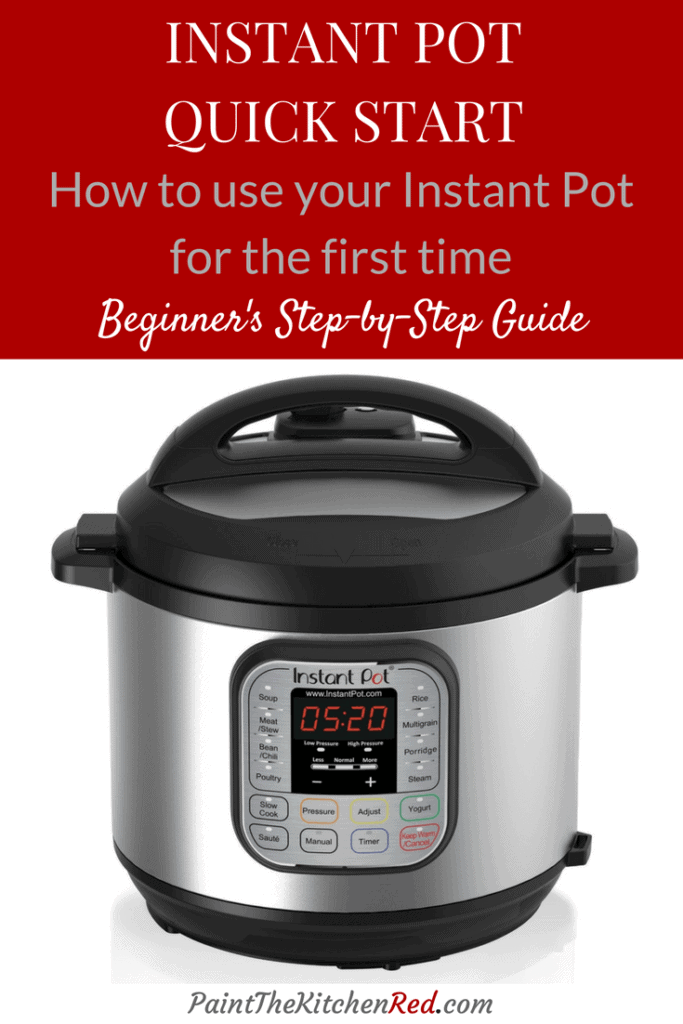
How to use an Instant Pot comes down to a few steps. Put the inner pot in the base, add at least 1 to 2 cups of thin liquid, close the lid and make sure the steam release is on Sealing. Press Pressure Cook (Manual on older models) and set the time. Your Instant Pot heats up, seals, counts down and beeps. Then you release the pressure and open the lid once the float valve drops. This beginner’s quick start guide walks you through each of those steps on any model, starting with a water test before your first real meal.
This post contains affiliate links. As an Amazon Associate, I earn from qualifying purchases. Please read the disclosure.
Find Your Answer
- Which Instant Pot Do You Have?
- Quick Start in 5 Steps
- Instant Pot Parts
- Setting Up Your Instant Pot
- Instant Pot Water Test
- How to Open and Close the Lid
- Sealing vs Venting and the Float Valve
- Natural Release vs Quick Release
- The Buttons You Actually Need
- Liquid, Fill Lines and Timing
- Trivet, Pot-in-Pot and Accessories
- Safety Basics
- Find Your Model's Manual (PDF)
- Your First Instant Pot Recipes
- If Something Goes Wrong
- FAQs
ℹ️ Introduction
I wrote the first version of this guide in 2016, right after my first Instant Pot arrived. The booklet in the box left me guessing about the most basic things. Judging by the hundreds of comments since, I wasn’t the only one.
Since then I’ve owned a long list of Instant Pot models, and they don’t all work the same way. The biggest difference for a beginner is the lid, so that’s where I’ll start.
The rest is pretty similar between the different models. I will note anything that may be different with your model.
What readers say about this guide
“Glad I looked up IP Manual on google and yours was the first one that didn’t have a PDF after its title… You are the golden standard every company should model their manuals after.” – Sherry Morgan
“My Instant Pot sat on my counter for a year, and we finally used it today… Thanks to your site, we knew what to do.” – Joanne
“Your step by step process was perfectly helpful. I am 65 years old and have used a stove top pressure cooker all my life.” – Betsy
“Thank you for clear, concise directions, and the photos help to clarify. You could teach a master class on the Instant Pot!” – Lindsay
If you know your model and want its own walkthrough, jump to find your model’s manual.
🔎 Which Instant Pot Do You Have?
Look at the top of the lid. On most models, the part that lets steam out, the steam release, comes in one of three styles. A few newer models have none of them (see below). Once you know yours, the rest of this guide is easy to follow.

- Steam release handle: a removable knob you turn by hand between Sealing and Venting. You have to turn it to Sealing yourself every time. Older versions of the Duo, Duo Plus and Duo Gourmet have one, and so do the Duo Mini, Lux, Smart WiFi and Duo SV.
- Steam release button: a round button that can be pressed and turned.
- Steam release switch: a slider marked Seal and Vent.
Button and switch models seal on their own, which is handy. Just remember to set them back to venting for the programs that don’t use pressure (sealing vs venting).
⚡ Quick Start in 5 Steps
If your Instant Pot is still in the box, start here. Every step links to the details further down.
- Unbox it and check the parts. Take everything out, including whatever is packed inside the inner pot, and check it against the parts list. Do it soon. If something is wrong, you want to find out while it’s under warranty.
- Set it up. Put the inner pot in the base, slide on the condensation collector and plug it in (setting up).
- Do the water test. It takes about 20 minutes and shows you how a pressure cycle looks and sounds (water test).
- Learn two things: Sealing vs Venting, and natural vs quick release (sealing and venting, releasing pressure).
- Cook something simple from a tested recipe (first recipes).
🔩 Instant Pot Parts
Your Instant Pot comes in three main pieces, plus a few extras. Here’s what’s in the box and what each part is called.
➡ Is your Instant Pot clicking? This is pretty normal!

- Base (outer pot): the housing with the heating element, the control panel and the power cord. Never put food or water straight into it.
- Inner pot: the removable stainless steel pot you cook in. People also call it the liner or insert.
- Lid: the pressure cooking lid. It locks onto the base and seals.
- Condensation collector: the small plastic cup that slides onto the back of the base and catches drips.
- Power cord: detachable on some models, built in on others.
- Accessories: usually a trivet (steam rack), and on some models a rice paddle, soup spoon, measuring cup or a spare sealing ring. Some bases have a small notch under the handle to rest the spoon in.
Instant Pot Lid Parts Diagram
The outside of the lid (top view):

- Lid handle: what you hold to turn the lid on and off.
- Lid fins: slot into the handles on the base, so you can stand the lid upright instead of setting it on the counter. Some smaller models, like the Lux Mini, don’t have them.
- Steam release: the handle, button or switch from the section above. People also call it the pressure valve, steam valve or venting knob.
- Float valve: the small silver pin (some people call it the floating valve) that pops up when your Instant Pot is under pressure and drops when it isn’t.
The inside of the lid:

- Sealing ring: the silicone ring (gasket) that seals the lid. It has to sit snugly in its metal rack all the way around.
- Sealing ring rack: the metal rim that holds the sealing ring.
- Anti-block shield: the metal cover over the steam release pipe that keeps food out of it.
- Float valve cover: the small silicone cap on the bottom of the float valve. It’s tiny and easy to lose, and the float valve won’t seal without it.
- Lid locking pin: keeps the lid from opening while there’s pressure inside.
How to Take the Lid Apart and Put It Back Together
Every part on the lid comes off for cleaning. Take them off one at a time and put each one back before you move on, so nothing ends up in the wrong spot.
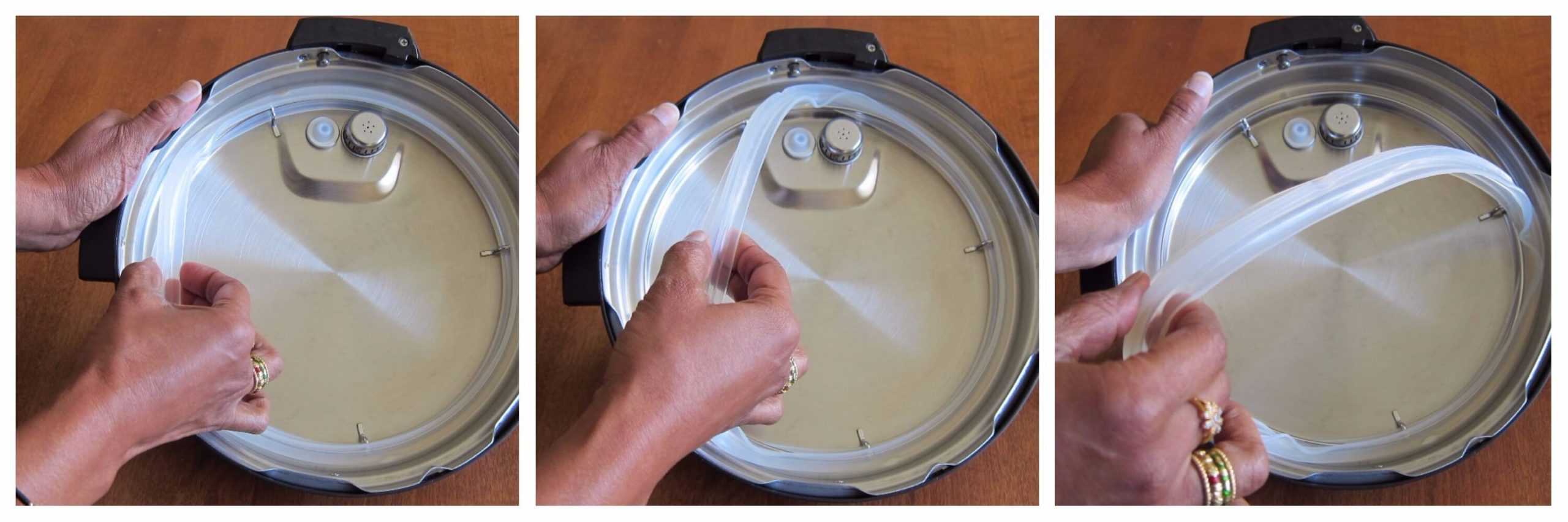
- Sealing ring: pull it out of its rack. To put it back, press it into the rack all the way around. Once it’s in, it should turn in the rack with a little effort but not fall out when you flip the lid.

- Steam release valve: pull the steam release valve straight up to take it off. Push it back onto the metal pipe to put it back on. On some switch models, remove the diffuser cover first and then remove the steam release valve.

Whisper Quiet lids: some newer models have a Whisper Quiet lid. From the top, you only see the steam release switch. The steam release valve and the float valve sit under a cover, and the float valve has a small silicone cap on top.
Open the cover to take them out. On the Duo Plus with Whisper Quiet, there’s an orange pull tab under the cover that has to come out before you cook, or it won’t seal (more on the orange tab).

- Anti-block shield: push it sideways toward the edge of the lid and lift. A flexible silicone trivet or a towel gives you a better grip.

- Float valve: pull the float valve cover off the bottom of the float valve, and the float valve drops out the top. To put it back, drop the float valve in from the top, then push the cover back on from underneath.
🔌 Setting Up Your Instant Pot
Set the base on a flat, stable counter, away from the stove, with room above it. The steam can damage cabinets, so don’t park it under one.
Put the Inner Pot in the Base

Make sure the base is empty and clean, then set the inner pot inside. I leave the trivet in the base whenever the inner pot is in the sink, so nobody in my house pours water straight into it.
Attach the Condensation Collector

Line the collector up with the notches on the back of the base and slide it in until it stops. It catches the water that drips off the lid rim when you open it. This is the part I couldn’t figure out at first. I kept trying to fit it inside.
Plug It In

If the cord is detachable, push it firmly into the base, then plug it into the wall. The display shows OFF, which means it’s on standby and ready. Some newer models show Ready instead.
🧪 Instant Pot Water Test
The water test is a short pressure cycle with plain water. It checks that your Instant Pot seals and builds pressure, and it lets you see and hear a full cycle before there’s dinner at stake. Do it before your first recipe, and again any time your Instant Pot won’t seal.
- Pour 1 cup of water into the inner pot of a 3-quart, 1½ cups into a 6-quart or 2 cups into an 8-quart. Instant’s own instructions use 3 cups. That works too, it just takes longer to come to pressure.
- Close the lid. On a handle model, turn the handle to Sealing. On a button or switch model, check that it’s on Sealing or Seal.
- Press Pressure Cook (Manual on older models). On models with a dial, turn it to Pressure Cook and press it.
- Set the time to 5 minutes with the + and – buttons or the dial. The display shows 5 or 00:05, depending on the model.
- On models with a Start button, press it. Others start on their own after about 10 seconds.
- The display shows On while it heats up. On some newer models, the display show the word Preheating on the display while others have a Pre-heating progress bar on the bottom of the display. Some steam and hissing from the lid is normal at this stage, and you might notice a plastic smell the first time. Keep your hands and face away from the steam.
- When the float valve pops up, your Instant Pot is sealed. A few minutes later the display switches from On or Preheating to the countdown.
- It beeps when it’s done. If Keep Warm is on, the display shows L0:00 (it can look like L000) and counts up the time since cooking ended.
- Press Cancel, then release the pressure. Turn the handle to Venting, press the button down or slide the switch to Vent. Keep your hand off to the side, not over the top.
- When the float valve drops, open the lid, pour out the water and dry the inner pot. You’re ready to cook.


If it never seals, or it hasn’t counted down after 30 minutes, check why your Instant Pot isn’t sealing. If a message or code shows up, see the burn message or Instant Pot error codes.
🔒 How to Open and Close the Lid
Close the Lid

- Set the lid on the base with the arrow on the lid lined up with the open lock symbol on the base.
- Turn it clockwise until it stops. Most models chime when it locks, if the sound is on.
- The arrow now lines up with the closed lock symbol.
If the lid won’t turn, check that the sealing ring is pushed into its rack all the way around. On a handle model with hot food inside, set the handle to Venting first, close the lid, then turn it back to Sealing.
Open the Lid

- Make sure the float valve is down.
- Turn the lid counterclockwise until the arrow lines up with the open lock symbol, then lift it off.
- Tilt it away from you as you lift, so the steam goes the other way.
If it feels stuck right after cooking, wiggle it gently. That’s suction, not pressure. Never force it while the float valve is up.
💨 Sealing vs Venting and the Float Valve

These two positions are what readers get mixed up about most.
Sealing (Seal) keeps the steam in, so your Instant Pot can build pressure. Use it for every pressure cooking program. How it works depends on your lid type.
- Handle style: turn the handle clockwise to seal.
- Button style: it auto-seals when you close the lid. If you need to move it from Vent to Seal, flick the button counterclockwise.
- Switch style: on most models the switch seals itself when you close the lid. If you need to move it from Vent to Seal, slide the switch to the Seal position.
Venting (Vent) lets steam out. Use it to release pressure, and for programs that don’t use pressure: Slow Cook, Yogurt and Sous Vide.
- Handle style: turn the handle counterclockwise to the Venting position.
- Button style: press the button down until it clicks into place.
- Switch style: slide the switch to the Vent position.
Float Valve Up or Down


Up means there’s pressure inside and the lid is locked. Down means there’s no pressure and it’s safe to open. Depending on the model, the float valve sits above the lid or level with it when it’s up, and level with the lid or just below it when it’s down. The two photos show both kinds.
Don’t push the float valve down to hurry it along. It drops on its own when the pressure is gone.
What’s Normal
- Steam and hissing while it heats up, before the float valve pops up.
- A wobbly steam release handle. It’s built that way. If you pull it up, it spins all the way around, but pushed down it only turns between Sealing and Venting.
- Clicking sounds while it heats, and a quiet countdown once it’s sealed.
- A wisp of steam now and then once it’s sealed, especially with soups.
Steam that keeps pouring out once it’s sealed isn’t normal. My Instant Pot troubleshooting guide covers that and about 50 other problems.
⏱️ Natural Release vs Quick Release
When the countdown ends, there’s still pressure inside, and you release it one of two ways. Follow whatever your recipe says.
- Natural release: leave it alone. The pressure drops on its own as it cools, in 10 to 45 minutes depending on how full it is. I use it for meat, beans and anything starchy or foamy.
- Quick release: move the steam release to Venting right away. Steam shoots out for a minute or two. I use it for vegetables, seafood and anything that overcooks easily.
- 10-minute natural release: let it sit 10 minutes, then quick release the rest. Lots of recipes use this one.
If foam or liquid sprays out during a quick release, set it back to Sealing, wait a few minutes and try again. More on picking one: natural release or quick release.
🔘 The Buttons You Actually Need

There are a lot of buttons, and you can skip most of them. These five are the ones I use almost every time. The numbers match the photo above.
- Pressure Cook: called Manual on older models. Same thing. You set the time and it pressure cooks on High.
- Sauté: browns and simmers with the lid off. Press it again (or Adjust on older models) to switch between Less, Normal and More heat.
- Cancel: stops whatever it’s doing and goes back to OFF.
- Start: only on some models. The rest start on their own about 10 seconds after you set the time.
- + and –: change the cooking time. On models with a dial, like the Pro and Duo Evo Plus, you turn the dial instead.
Setting the Time
Most displays read hours and minutes. 00:06 is 6 minutes, and 06:00 is 6 hours. Readers have turned spaghetti to mush this way, so check it before you walk away.
The time in a recipe is the pressure cooking time only. Your Instant Pot also needs time to come to pressure first and to release it after. A recipe with 15 minutes on High takes 40 to 55 minutes from start to finish with a natural release.
On older Duos, the Timer button is actually a delay start, which is why it moves in big jumps. To set a cook time, press Manual or Pressure Cook first. On newer models it’s called Delay Start. Here’s how to use Delay Start.
High and Low Pressure
Most recipes use High, which is the default. Low is for some rice recipes, quick-cooking vegetables and fish. Depending on the model, you switch with the Pressure Level button, the Adjust button or on the display.
Programs and Default Times
Buttons like Soup/Broth, Meat/Stew and Bean/Chili are presets. They pressure cook for a set time, a lot like the popcorn button on a microwave. Pressing the button again switches between Less, Normal and More. These are the defaults on the Duo. Other models are close, but not identical.
| Button | Less | Normal | More |
|---|---|---|---|
| Bean/Chili | 25 minutes | 30 minutes | 40 minutes |
| Cake | 25 minutes | 40 minutes | 50 minutes |
| Egg | 3 minutes | 4 minutes | 5 minutes |
| Meat/Stew | 20 minutes | 35 minutes | 45 minutes |
| Multigrain (Soaks for 45 minutes first) | 20 minutes | 40 minutes | 60 minutes |
| Poultry | 5 minutes | 15 minutes | 30 minutes |
| Porridge/Oatmeal | 15 minutes | 20 minutes | 30 minutes |
| Pressure Cook | 20 minutes | 35 minutes | 45 minutes |
| Rice | – | 12 minutes (Low Pressure) | – |
| Soup/Broth | 20 minutes | 30 minutes | 40 minutes |
| Steam | 3 minutes | 10 minutes | 15 minutes |
| Slow Cook | 180–190°F (similar to keep warm on slow cooker) | 190–200°F (similar to low on slow cooker) | 200–210°F (similar to high on slow cooker) |
| Yogurt | 106°F to 113°F (for Chinese fermented rice) | 110°F to 115°F (for incubating yogurt) | 160°F to 180°F (for boiling milk before incubating) |
If you’d rather not guess, use Pressure Cook and the time in your recipe. That’s what I do.
Other Buttons
| Button | What it does |
|---|---|
| Start | Starts the program (some models only) |
| Cancel | Stops the current program and goes back to standby |
| Delay Start (Timer on older models) | Starts cooking later |
| Keep Warm | Keeps food warm after cooking and counts the time since it finished |
| Pressure Cook (Manual on older models) | Pressure cooks for the time you set |
| Pressure Level | Switches between High and Low pressure |
| Sauté | Browns and simmers with the lid off |
| Sous Vide | Holds water at a set temperature for sous vide (some models) |
| Fav | Saves your own settings (some models) |
| Temp and Time | Change the temperature or time with + and – (some models) |
| Ultra | Custom pressure, temperature and time (Ultra only) |
Models with an air fryer lid also have Air Fry, Roast, Bake, Broil, Dehydrate and on some, Proof. If you’re not sure what an icon on your display means, here’s my guide to Instant Pot symbols and icons.
📏 Liquid, Fill Lines and Timing
- Use enough thin liquid. Your Instant Pot needs steam to build pressure. That means at least 1 cup in a 3-quart, 1½ cups in a 6-quart and 2 cups in an 8-quart. Water and broth count. Thick sauces don’t.
- Don’t overfill. Stay under the ⅔ line, or the ½ line for food that foams or swells, like rice, beans and pasta.
- Deglaze after Sauté. Pour in a little liquid and scrape the bottom so nothing stays stuck. Stuck bits are the most common cause of the burn message. Here’s how to deglaze.
- Layer thick ingredients on top. Put thin liquid on the bottom and tomato sauce, pasta or rice on top, without stirring.
- Halving a recipe: keep the cook time the same and don’t go below the minimum liquid. Smaller amounts come to pressure faster, but they don’t cook faster once they’re there.
How long it takes to come to pressure is in the FAQs. For pressure cooking times by ingredient, see my Instant Pot cooking times chart.
🍽️ Trivet, Pot-in-Pot and Accessories
The trivet that comes with most models lifts food out of the water when you steam eggs or vegetables, with Steam or Pressure Cook. It’s also how you cook pot-in-pot. Water goes in the inner pot, the trivet sits on top, and a smaller oven-safe dish goes on the trivet. Rice and cheesecake are classic pot-in-pot recipes.
These are the extras I’d actually buy:
- A trivet with handles, if yours didn’t come with one.
- A small dish for pot-in-pot. Any oven-safe glass, ceramic or stainless steel dish works.
- An extra sealing ring, so desserts don’t pick up curry smells. If your Instant Pot came with two rings, use one at a time.
- A tempered glass lid for Sauté, Slow Cook and Yogurt.
⚠️ Safety Basics
Your Instant Pot has a lot of safety features built in, like the lid lock and the pressure sensors. Your part is short:
- Always have the inner pot in the base before you add anything. If water gets into the base, unplug it and let it dry out completely before you use it again.
- Keep your hands and face away from the steam release when steam is coming out.
- Don’t cover the steam release, and don’t move your Instant Pot while it’s under pressure.
- Don’t open the lid until the float valve is down.
- Use oven mitts on the inner pot and the metal parts of the lid. They get hot.
📘 Find Your Model’s Manual (PDF)
Instant posts the official owner’s manual for every model, as a PDF, on its manuals and resources page. Find your model’s name on the front of the base or on the label underneath.
If you’d like a walkthrough with photos, I’ve written beginner guides for these models:
- Instant Pot Ultra
- Instant Pot Duo Evo Plus
- Instant Pot Duo Nova
- Instant Pot Duo Gourmet
- Instant Pot Duo Crisp
- Instant Pot Pro
- Instant Pot Pro Crisp
This guide covers the Duo and other handle models, so there’s no separate Duo guide.
Also check out all my Youtube videos for the above models.
🥘 Your First Instant Pot Recipes
Don’t improvise your first few meals. Pick a tested Instant Pot recipe and follow it as written, liquid and all. Once you know how your Instant Pot behaves, you can start adapting your own.
Rice was the first thing I made, and I still recommend it. Jasmine rice and hard boiled eggs are hard to get wrong. After that, try Instant Pot Chicken Stew, Instant Pot Chicken Curry Soup, Instant Pot Thai Red Curry, Instant Pot Pork Carnitas, Instant Pot Mac and Cheese or Instant Pot Chana Masala.
🛠️ If Something Goes Wrong
- Instant Pot troubleshooting, with about 50 common problems in one place
- Not sealing or pressurizing
- Burn or Food Burn message
- Error codes like PrSE, NoPr and C7
- More Instant Pot tips and FAQs
❓ FAQs
Plug it in. There’s no power button. The display shows OFF (Ready on some newer models), which means it’s on standby. If the display stays blank, press any button, and check that a detachable cord is pushed all the way into the base.
Press Pressure Cook (Manual on older models), set the time, and press Start if your model has one. Models without a Start button start automatically after about 10 seconds, and the display changes to On or Preheating.
For pressure cooking, set the steam release to Sealing. A handle points to Sealing, a button is up and a switch is on Seal. The float valve pops up on its own once there’s pressure inside, and it’s safe to open the lid when it drops.
About 10 minutes with a couple of cups of liquid. A full pot, lots of liquid or frozen food can take 15 to 30 minutes.
Instant has the official manual for each model on its manuals and resources page. Check the model name on the front or underneath the base first.
If you found this article helpful, please share it on social media using the social media share buttons at the top and bottom of this post. Thank you so much!


Sherry says
Are these Instructions available to print?
Neena Panicker says
Sherry, I’m sorry but you’d have to right click in your browser and print the web page.
Diane says
Just opened my duo plus. I did the water test. My question is when I finished and hit cancel it never switched to OFF , it just said READY. I’m worried it’s not safe to unplug if it’s not actually off.
Paint the Kitchen Red says
Diane, that’s a newer message. It means the same as “off” for other models. You should be fine unplugging it.
Terri Moses says
Help, my instant pot has never shown an L and count up in time when done, it’s always on keep warm.
Paint the Kitchen Red says
Terri, does it just turn off? What happens on the display when it’s done pressure cooking? If it’s going to OFF,then there’s something wrong with the keep warm functionality.
Lavonda says
I have a insta pot and just now trying it out but I need help not sure bout water test not sure if I did it right.csn you pls help willing to do a facetime 😂 I’m dying to try s small roast today if possible pls help
Paint the Kitchen Red says
Lavonda, unfortunately I’m not able to do a one-on-one call but I have so many resources that can help you. If you’re more of a visual learner, I have very detailed youtube videos that go over the water test.Let me know your model and I can share a link with you.
Jerry Eskew says
How do I change the cook time — increase or decrease on any setting?
Paint the Kitchen Red says
Jerry, it depends on the model. On the Duo, you press ‘pressure cook’ and then press + or – to change the cook time.
Marguerite says
I put water in and it all came out of the bottom on floor what would cause it not to hold water
Paint the Kitchen Red says
Marguerite, you need to put the stainless steel inner pot (liner) in the base unit before you add anything. You’ll need to make sure the Instant Pot completely dries out before you turn it on or it can short-circuit.
Zandra Peterson says
Hi, I bought the IP Duo 8quart 4 yrs ago. Just now opening it and going to try it out. Just wanted to know where I get replacement parts ie. Sealing ring. Also do you know if there’s a Sous Vide attachment for this model? I saw one at the the store 2yrs ago and should’ve bought it then. Thank you for helping all us newbies out🤗
Paint the Kitchen Red says
Zandra, replacement sealing rings and other parts can be purchased on the Instant website or on amazon. There are sous vide wands that work independent of the Instant Pot. They can attach onto the inner pot or just a deep pot.
Bernadette Vines says
I wish I’d found your page when I first bought my IP Dou about 2 years ago. I wasn’t confident in the use so it’s sat in the corner hardly being used. Now I’m more excited because I know how to cook in it AND how to take care of it.
I’m very excited to try some of your recipes!!
I have the 3qt model to cook for one so hopefully you have recipes for smaller batches.
Paint the Kitchen Red says
Bernadette, I think my recipes will work in the 3 quart as written. However, you can cut them in half or 2/3. The only time this becomes an issue is a recipe that has a minimal quantity of liquid. You’d need to experiment with those recipes. Welcome!
PRagna says
Can I use Instant pot recipes for my nutricook smart pot multi cooker.
Paint the Kitchen Red says
Pragna – I don’t see why not. However, you might need to adjust the cooking times. With some experimenting, you might figure out that you need to modify recipes by x percent more pressure cooking time.
Col says
Thank you for this useful info. I just bought my Instant pot in China ( I live here) and from my translations of the screen, they look different from the manual I downloaded in English. I’m assuming I should go with what is on the pot… I made simple sweet potatoes today as a first dish. So quick and so yum. Excited to learn more.
Paint the Kitchen Red says
Happy to help – glad it all worked out for you!
Linda Henderson says
I want to make yoghurt in an instant pot, but want to know if I can put glass jars containing the milk and started I to the instant pot to culture at a steady temp for the required time. I’ve only read about it being made in bulk in the inner pot.
Neena Panicker says
Hi Linda, yes you can use glass containers. I put them on a wire rack (no water below) and it works great.
Julie S. says
Excellent site! I wish this content was shipped with my IP! I have a 3 quart Duo that I’ve had for about a week. How do I scale down recipes which are generally written for 6 quart IPs. I’m thinking more in terms of timing and how much liquid to (not?) include. I can scale the ingredients but would like more guidance on what else needs adjusting. Perhaps you have an article about that?
Paint the Kitchen Red says
Julie, thanks for reaching out. I don’t have a guide for the 3-quart. You can scale recipes down for the 3-quart but you have to keep a few things in mind:
– cook time stays about the same.
– the quantity of liquid shouldn’t go too low. e.g. if you have a recipe for the 6 quart that has a minimal amount of liquid to start with, it might not be an option to scale that recipe.
– the 3 quart might have some variation in how fast the food cooks, you might need to do some experimentation.
Hope that helps.
JulieS says
Thank you – that does help. I appreciate the reply! Lots of experimentation with this tool.
Joyce says
Towards the base of the Instant Pot, there is a hole, where the silver and the black meet. Below the handle on the right. Is that meant for anything specific? I thought maybe a cup or holder for the spoons might go in that spot but I don’t remember the Instant Pot coming with a holder.
Paint the Kitchen Red says
This notch is not available on all models, but you can rest in there the spoon or ladle that’s shipped with some models.
Ann says
Should the steam valve be closed on all cooking functions… such as slow cook or baking.
Enjoyed all the info and recipes you shared.
Thanks, Ann
Paint the Kitchen Red says
Ann, I leave the steam release valve open for sous vide, slow cook, and dry baking (available on only some models – “no pressure” custom setting).
Susan says
Hello, I am new to the instant pot. When I press manual I am unable to set/adjust the time. It immediately says On. Once it is pressurized a random time appears that I am still unable to adjust.
I did a test run using the steam button. I was able to set the time etc and all good.
Is my manual button defective?
Paint the Kitchen Red says
Susan, it sounds like pressing the Manual button is beginning the cooking process immediately, rather than taking a few seconds to start up. That doesn’t sound right. What you could do is find another button that works e.g. Meat and it should work just about the same as the Manual button. Or if you have the option to return/exchange it, I would try that.
Carol says
I recieved the insta pot duo nova as a 2019 Christmas gift. I hate it. It’s confusing and feel it’s a total waste of money. I also don’t like the taste of the food cooked in it. The food as no taste. I would not recommend it
Paint the Kitchen Red says
Carol, I’m sorry that you’ve had a bad experience. Here’s the thing: the Instant Pot is an appliance that has its strengths but can’t be used for everything. e.g. there are many recipes out there that don’t produce the best results e.g. cakes or recipes with lean meats. In addition, if you’re using too much water or liquid, the results will be watered down and bland. If you’re adapting your own recipes, you might consider increasing the quantity of spices. I don’t what type of recipes you like, but you might want to try some of mine. They are not bland 🙂
Joycelyn Roney says
My IP came with an orangerubber ring and I can’t figure out where it goes
Paint the Kitchen Red says
Joycelyn, some models ship out with an extra sealing ring. You can use it for desserts only, or you can save it as an extra for when your original gets damaged or stretched out.
Mary Lou says
I HATE this appliance!,,,
Paint the Kitchen Red says
Mary Lou, oh no – I’m so sorry to hear that you’re so frustrated. Make sure you read my guides on burn message and sealing problems. Feel free to reach out to me with specific questions.
Kristen says
I have a few favorite recipes that I would like to do in my IP. How do I convert the recipe? It’s easy to put it all in at once, but how do you adjust how long it needs to cook?
Paint the Kitchen Red says
Kristen, the best way is to look at a similar tried and tested pressure cooker recipe and use those timings and liquid quantities. There’s no set rule of thumb. Sometimes, it’s trial and error 🙂 Let me know if you have specific questions, I can do my best to help you out.
Terry says
Hello, How do I set the instant pot to hours? I have a Instant Pot LP Duo. I can only get it to minutes. The only numbers that light up, are the two middle ones on display. It goes to 120 minutes, but not hours (example: 2:00 hours)
Thank you
Paint the Kitchen Red says
Are you sure it’s 120 minutes and not 1 hour 20 minutes?
Joanne says
Your articles are amazing – my Instant pot sat on my counter for a year, and we finally used it today. I used a generic recipe I found online, and apparently we cooked too long. We got the Food Burn warning. But thanks to your site, we knew what to do.
Is your instructions article available in printed form? I would love to have it on paper instead of just online.
Paint the Kitchen Red says
Hi Joanne, thank you very much for your request. I’m sorry to say it’s not available in printed form.
carol says
How long does it take to preheat before automatic rice program starts?
Paint the Kitchen Red says
Carol, the amount of time an Instant Pot takes to come to pressure and begin cooking depends on the quantity of food and liquid. So for 2 cups of liquid and rice, it takes less than 10 minutes. For a larger quantity, it takes longer.
Maryle Peterson says
This is a very helpful page. Wish I would have seen it the day my IP arrived. I have made some great meals in it already. I have the 3qt Duo Nova. When making soup the other day, using the soup button I found it was letting off steam from the top even though I had it in seal. It did this for sometime without building pressure and I knew the soup would be hot enough, so I pushed cancel. Would it have built pressure if I had waited? Is it correct that some pressure releases when in soup mode?
Paint the Kitchen Red says
Maryle, depending on how much soup you had in the IP and the initial temperature, it can take a while to come to pressure even after it starts releasing some steam. I would try again and give it some time after it starts steaming (maybe 10 minutes or so).
Carol says
hi, my name is carolina. Is the pressure release valve supposed to be able yo turn 360°??
Your articles is great and very informative!!
Thank you
Paint the Kitchen Red says
Carolina, yes it does turn 360 degrees if it’s pulled up a bit. But when it’s in the proper position and pushed in all the way, it should only turn from ‘venting’ to ‘sealing’ and back.